
Welcome to the first episode of Indeviews! In the first episode I am honored to host an interview with the creator of Proteus, Ed Key.
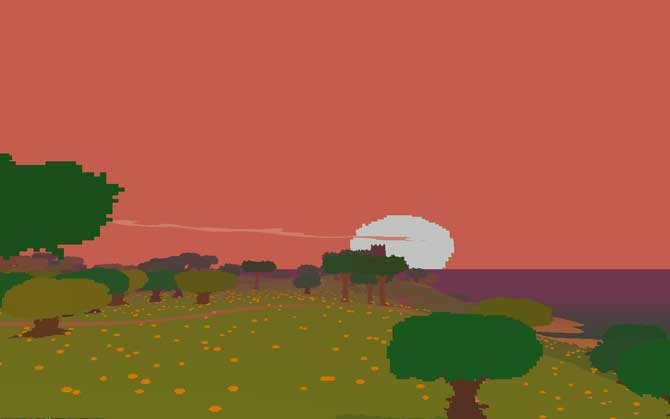
Proteus is a unique gaming experience, where through exploration and subtle interaction with your surroundings, you create a new story every time you travel through its procedurally generated islands. Also the ambient sounds and the soundtrack of the game immerse you even more into the game.
So without further ado, let’s get to it!
❖
Which game engines/game making tools do you use for your games? Did you build your own? If you have used different engines/game making tools, which one is your favorite and why?
Ed: Proteus is written in C# and uses OpenGL and SDL for graphics, SDL for audio and Lua for scripting (just for some initialisation and world definitions). The framework is pretty much made from scratch, by me and my friend Alex May some years ago. I also dabbled a bit with Flixel in the past but haven’t used any integrated Game-making tools like Game Maker. When I worked in commercial games it was all C and C++ any proprietory engines.
What programming language do you prefer developing your games on? Why do you choose it over others?
Ed: At the moment I’m using C#. I find it’s fairly quick and pleasant to work in although I miss some C++ features. People should just whatever they’re most comfortable with for what they want to do.
Do you use third party tools (map editors, sprite managers, animation suites, etc) or you build your own?
Ed: I tend to use existing free software (e.g. Sketchup, Tiled Map Editor) and write my own importers or exporters as needed. I never really have the motivation to write my own tools beyond that.
Which tools and applications you usually use when developing a game (favorite IDE, text editor, do you use static analysis tools, revision control system etc)?
Ed: Visual Studio for C# coding and debugging, Notepad++ for editing Lua, SVN for version control. I briefly used Redgate profiling tools for .NET, which was really impressive.
Is there any specific library, framework that you always use on your games?
Ed: Well, I’ve only released one game, but for all the prototypes I did on the side in that period I used the same framework. I’m going to investigate Unity3D for the next project, as it seems like having all the foundation done for me will be a wise move. I’m also looking forward to being about to put builds online and on iOS without much trouble.
What is your computer setup? Do you use Mac or PC? What specs? Do you have a dual monitor setup?
Ed: PC. Currently a laptop plugged into an external monitor and keyboard. It’s a quad core i5 2.5GHz, 8GB RAM, SSD, Nvidia graphics of some sort. It’s nice to have the flexibility of the laptop but I’m going to ge a desktop PC for future projects just for some smoother performance with Unity.
Do you have any photos from your workplace?
Ed: I couldn’t bring myself to photograph my screen and desk, so here’s a better picture taken from my desk.

Which games inspired you the most? Do you have a favorite developer from the games industry (indie or not)?
Ed: Michael Brough’s VESPER5 is one that has sparked off a lot of thoughts in my head recently. I also loved Julian Gollop’s strategy games, from Chaos to XCOM/UFO, so I’m looking forward to his new version of Chaos that he’s currently working on. I like a ton of other developers too, too many to mention. I don’t have a favourite in that sense.
What’s the single piece of advice that you would always give to someone, and what is something that you will absolutely avoid/never do again?
Ed: A thing I learnt about playtesting when working on Proteus: Once your game is in a workable state, test it on real people who haven’t played an previous versions and have no information about it. Do it in person, at home, in a cafe, whereever. Do not speak or help them whilst they play! If they get stuck, you have to absorb that frustration yourself and go back to your game and figure out what you should do with that. I think if you do this kind of testing properly and honestly it can make a huge difference to how your game is understood and recieved by people once it is released for real. If you don’t have people to test with locally, you could perhaps try twitch.tv or Skype screen-sharing.
What is your opinion on the rise of free game development “suites” like Unity, UDK, CryEngine etc? Do you feel interested in using them for your next projects?
Ed: They’re great. I haven’t used them much so far as it’s such a habit for me to just use code and a folder full of assets, but people make great stuff with them. I’ve got no time for people who are snobs about technology when it comes to game-making. I’m planning on investigating Unity3D for future, as I said above. Apparently there are some patterns to using it which are more “coder-ish” so I’m looking forward to exploring it.
What are your future plans? What games are you working on right now?
Ed: Still working on some post-launch stuff for Proteus, but after that I’ve got another idea for an exploration game that I want to play with. I made lots of little prototypes during Proteus and had ideas that weren’t a good fit for that project, so this is a companion piece in some ways.
Thank you for this interview Ed! That was a really interesting insight!
❖
Stay tuned for the second episode, next week! :)
Note: If you are an indie game developer and wanna be part of the series, just send us an email at info@evilwindowdog.com